
Physical Therapy or Home Health Aide? How to Know Which Care Your Loved One Needs

It's a conversation that plays out at kitchen tables all the time: "Does Dad need therapy, or does he just need someone around to help him get through the day?" Sounds like a simple question. It isn't, really — not until someone breaks down what these two services are actually for.
Physical therapy vs home health aide in Idaho Falls gets thrown around like it's one decision, but it's really two different questions stacked on top of each other. Is there something here that can get better? Or is this about making today easier, regardless of whether anything changes? Once a family sees the split that way, most of the confusion clears out pretty fast.
The Real Difference: Rebuilding vs. Getting Through the Day
Yes, there is a big difference between physical therapy and a home health aide. Short version: a physical therapist is trying to change something. A home health aide is trying to support something as it already is. Neither one is the "bigger" service or the "smaller" one — they're just aimed at different targets, and mixing them up is how families end up either paying for rehab nobody asked for or missing help that would've made life a lot easier.
What physical therapy is actually doing
A PT isn't just watching someone walk across a room to be polite. They're looking for specifics — where the balance breaks down, which muscle isn't pulling its weight, why stairs suddenly feel like a cliff face. Then they build a plan around it. Exercises, gait work, balance drills, stretching, teaching safer ways to move through a house that maybe wasn't built with mobility issues in mind.
The goal isn't to do things for someone. It's to hand some of that ability back to them — or at least keep them from losing more of it. This tends to show up most after something happens: surgery, a hospital stay, a fall, a stroke. Something with a clear "before" and "after" that therapy can bridge.
What a home health aide is actually doing
Totally different job. An aide is there for the ordinary stuff — the shower that's become risky to do alone, the shirt buttons that fingers can't manage anymore, getting food on the table, getting to the bathroom safely. No improvement curve, no measurable goal chart on the wall. Just: today needs to go okay, and somebody's there to make that happen.
And honestly? This is where a lot of the quiet relief comes in for families. Loving someone and being their sole caregiver every single day are two very different things. An aide doesn't replace the love part — they just take some of the physical weight off your shoulders.
Signs Your Loved One Might Need Physical Therapy
Sometimes it's obvious. Hip replacement- of course there's PT. But a lot of the time it's slower than that — it sneaks in.
A recent fall, surgery, or injury. The surgery can go perfectly, and the body still doesn't just snap back. Weakness lingers longer than anyone expects. Motion doesn't return on its own. That gap is exactly what PT is built to close.
Falls especially deserve their own paragraph, because the damage isn't only physical. Someone who's fallen once often gets scared of falling again — and that fear makes them move more stiffly, more cautiously, sometimes barely at all, which (frustratingly) makes them weaker and more fall-prone. A good evaluation catches both halves of that problem, not just the physical one.
A slow decline in strength or balance. No incident, no surgery — just things getting harder, gradually, in a way that's easy to write off until it isn't. Struggling to get out of a chair. Grabbing the wall on the way down the hall. Taking forever to get dressed. Suddenly "not really using" the stairs anymore.
If you're sitting there wondering, does my parent need PT or a home aide — this is usually your answer key: if the thing underneath the struggle is something that could genuinely improve with the right exercises, that's a PT conversation. And it's worth having sooner rather than later. This stuff rarely gets better by waiting it out.
Signs a Home Health Aide Is the Better Call
Now flip it. What if nothing's acutely wrong — no fall, no surgery, no rehab goal on the table — but daily life is still a struggle?
No rehab goal, just day-to-day difficulty. Maybe it's not really a mobility problem. Maybe it's arthritis making buttons impossible, or fatigue that turns a shower into an ordeal. That's not a "fix the movement pattern" situation. That's a "someone needs to help, every day, full stop" situation — which is exactly the lane an aide operates in.
Any real Idaho Falls in-home care decision guide should push past the diagnosis on the chart and ask the more useful question: what can this person actually pull off on their own, today, without help?
Support during or after therapy wraps up. Here's the part families often don't see coming — finishing PT doesn't flip a switch that makes everything easy again. Someone can hit every single goal on their therapy plan and still need a hand in the bathroom, still need help getting dressed in the morning. That's not therapy failing. That's just... normal. An aide fits right into that gap, propping up the progress therapy made while covering what therapy was never meant to cover.
Can They Work Together? Pretty Much Always
Families tend to assume it's one or the other. It's usually not. Someone healing from a hip replacement might need PT three days a week and someone helping with bathing the other four. These aren't competing for the same job. They're just doing different parts of it.
How Momentum ties it together
Momentum doesn't treat rehab and daily support like two separate boxes on two separate forms. When it makes sense, physical therapy and home health aide services get built into one plan — not handed off as two disconnected referrals that never talk to each other.
The therapist stays focused on the measurable stuff: gait, strength, balance, safe transfers. The aide handles everything else — the parts of the day therapy was never going to touch. Two lanes, one plan, and a lot more ground covered than either service could manage alone.
For families weighing physical therapy vs home health aide in Idaho Falls, this kind of coordination matters most when things are shifting — right after a hospital stay, early in recovery, or anytime the situation feels like it's changing week to week instead of holding steady.
How to Actually Get Started
You don't have to figure this out with a guess and a shrug. An actual assessment beats guessing every time.
Still stuck on: does my parent need PT or a home aide? Start simple — write down the specific things they're struggling with, then ask whether those things seem temporary, or slowly getting worse, or tied to something that just happened.
What the assessment actually looks at
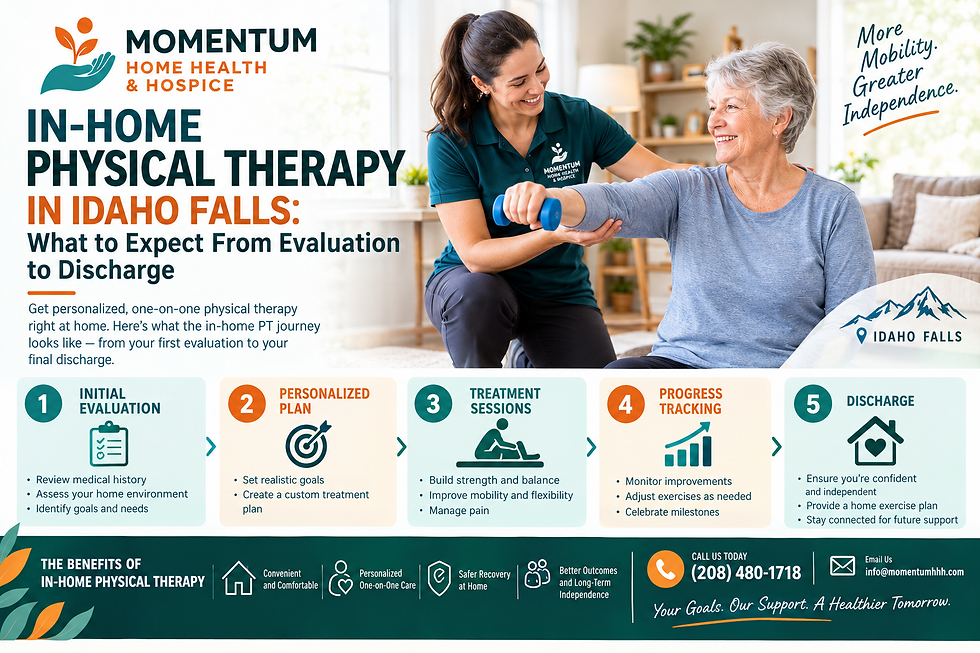
A decent initial assessment covers where they're at functionally — mobility, strength, balance, the daily routine, safety risks, what they actually want out of the next stretch of their life. It'll also account for anything recent: a fall, a surgery, a noticeable dip in activity.
The point of all of it is matching the service to the actual problem instead of the assumed one. If rehab could move the needle, PT gets recommended. If the daily grind is the real issue, an aide makes more sense. And a lot of the time — more than people expect — both are true, and a coordinated plan ends up being the smarter move.
This is exactly why an individualized approach matters so much in any Idaho Falls in-home care decision guide. No two households are running the exact same version of this problem. A diagnosis on paper doesn't tell you what someone needs day-to-day. Their actual home, their actual routine, their actual goals — that's where the real answer lives.
Call to Get Started
Getting home life safer and less stressful — for your loved one and for you — really does start with taking that first step to get clarity on what's actually needed. You're not supposed to have to figure this out solo.
Momentum Home Health can walk you through the options and help put together a plan built around what your loved one actually needs. Call to get started today and take that next step with confidence.
Wrapping Up
Once this stops being framed as an either/or, it gets a lot less stressful. Physical therapy vs home health aide in Idaho Falls was never really a competition between two services — it's about matching the right kind of help to the right kind of problem. Physical therapy works on rebuilding function. A home health aide supports the daily stuff that's stopped being manageable alone. And a lot of the time, the honest answer is both, working side by side. A professional assessment is the fastest way to find out where to actually start.
FAQs
Can physical therapy and home health aide care happen at the same time?
Yes — and it happens more than people think. Therapy chips away at strength, mobility, and balance goals while the aide handles the daily routine in between sessions. Put together, they usually cover more ground than either one manages solo, especially in the middle of a recovery.
Do you need a doctor's order for this?
It depends on which service and which payer. Physical therapy generally needs a physician's order for Medicare to cover it. Home health aide services are often bundled into a broader home health plan once someone qualifies for skilled care. Your provider can walk you through what actually applies before anything kicks off.
Can a home health aide stick around after PT ends?
Often, yeah. Wrapping up therapy doesn't mean daily tasks magically get easier overnight. If bathing, dressing, or grooming are still tough, continuing with an aide usually makes sense. How much and for how long comes down to the person's ongoing needs and what their coverage actually allows.
What's the best way to figure out which one my loved one needs first?
Start with an actual assessment instead of guessing off a diagnosis or a handful of things you've noticed. Ask whether the real issue is strength, balance, and mobility — or whether it's daily tasks that have quietly become impossible to manage alone. A proper in-home evaluation sorts out which one applies. Sometimes it's both.
Does Medicare treat PT and home health aide coverage differently?
Generally, yes. Medically necessary physical therapy tends to get covered once eligibility requirements are met. Home health aide coverage is narrower and usually only kicks in alongside qualifying skilled home health services. Worth double-checking the specifics with your provider and Medicare directly before anything starts.


Comments