
In-Home Physical Therapy in Idaho Falls: What to Expect From Evaluation to Discharge
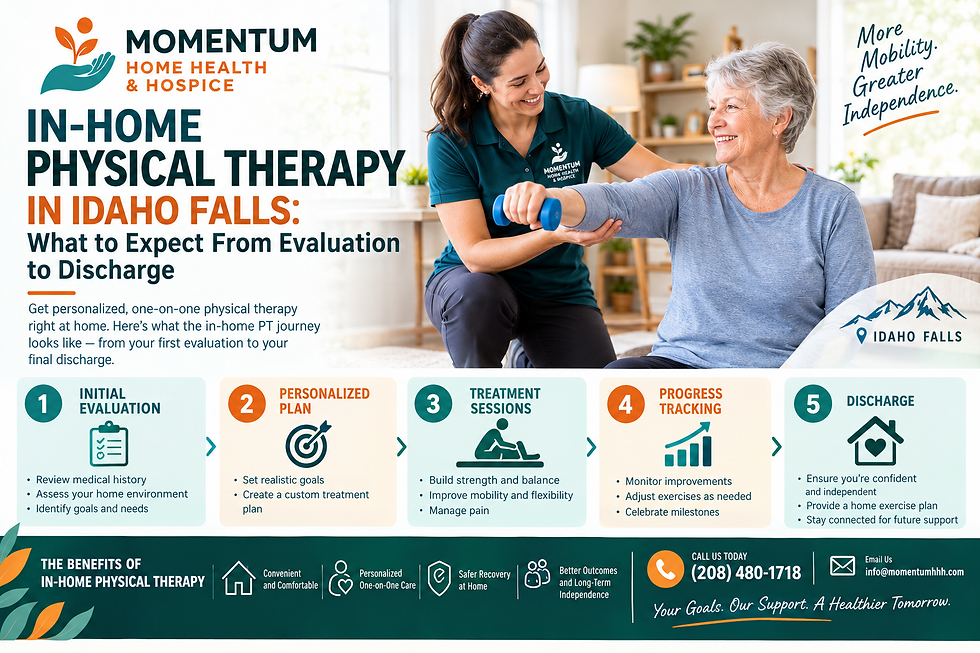
Let's be honest — recovering from an injury, surgery, illness, or a mobility setback is disorienting enough without also having to figure out how you're supposed to get to a clinic three times a week. If pain, weakness, balance trouble, or limited movement are already making your day harder, tacking on a car ride and a waiting room doesn't do you any favors. Physical Therapy in Idaho Falls doesn't have to work that way. It can come to you instead — evaluation, treatment, all the way through discharge — built around your condition, your goals, and the actual home you live in.
This is what makes in-home physical therapy in Idaho Falls the most sought-after healthcare solution over the last decade.
How In-Home Physical Therapy Starts
First things first: your therapist needs to know where you're actually starting from. Nobody hands you a workout sheet on day one. That's not how this works.
The initial evaluation visit
That first appointment runs deeper than most people expect. During a physical therapy evaluation at home, the therapist is going to ask about your medical history, whatever surgery or injury brought you here, your symptoms, your medications, your current limitations, and any rehab you've done before. Then they'll check strength, flexibility, balance, coordination, how you walk, your stamina — the usual clinical stuff.
But here's what actually matters more, honestly: can you get out of bed by yourself? Walk to the bathroom without grabbing onto furniture the whole way? Handle a flight of stairs, stand up from your favorite chair, move around your own kitchen without white-knuckling the counter? Those questions tell your therapist more about your real life than any strength test on a table ever could.
And for people getting in-home physical therapy in Idaho Falls, this first visit doubles as a walk-through of the house itself. A loose rug by the front door. A hallway that's a little too narrow. Stairs with no rail. Furniture crowding the path you take fifteen times a day. Small stuff, but it's exactly the kind of thing that turns into a fall — so it often ends up folded right into the plan.
Building a personalized treatment plan
Once the evaluation's done, your therapist puts together a plan around where you're starting and what you actually want to get back to. That could mean therapeutic exercise, balance training, gait work, functional practice, stretching, strengthening — some mix, depending on you.
None of it is locked in stone, either. Recovery isn't a straight line, and anyone who's been through it can tell you that. Some weeks you feel like you're flying; other weeks you're back to square one. So the plan bends with you. Someone a week out from surgery might spend that first stretch just working on safe transfers — getting in and out of bed, standing up carefully — before anything more ambitious even enters the picture.
What a Typical In-Home PT Visit Looks Like
A session isn't a checklist. Most visits start with a simple question: how have you been feeling since last time? Whatever the answer is shapes what happens for the next hour.
PT home visits in Idaho might lean toward mobility on one day, strength another, balance or pain management on a different day still — it depends entirely on what your body's telling everyone that week.
Exercises, mobility work, and hands-on treatment
Exercise usually carries a lot of the weight here. Could be targeting a specific muscle group, working a stiff joint, building balance, fixing posture, or just trying to get your endurance back up. Your therapist walks you through the movement first, then watches closely while you do it — form matters more than reps, especially early on.
Then there's the mobility side, which is really just practicing life. Standing up from a chair. Walking with a cane. Taking the stairs one at a time, or two, depending on where you're at. Moving from bed to chair without a scramble. None of it is abstract — it's the exact stuff you need for the rest of your day.
Hands-on treatment might come into it too, depending on your diagnosis. What that looks like changes a lot from person to person — there's no one-size template. The whole point is nudging you forward without pushing past what your body's ready for.
How the home environment shapes the session
Here's the real upside of doing this at home: therapy happens exactly where your problems actually live. Your therapist gets to watch you move through your own hallway, tackle your own stairs, get into your own bathroom — not some version of it built in a clinic.
That's what makes home rehab in Idaho Falls click for people whose struggles are tangled up with their actual living space. You're not rehearsing a movement on a mat and hoping it translates later — you're doing it with your own furniture, your own layout, the exact things you'll be using once therapy wraps up.
Sometimes the therapist will point out a small fix — clear this path, move that item somewhere easier to grab, put something sturdy within reach by the bed. Small changes. They add up more than you'd think.
How Progress Is Measured Over Time
Feeling a little better after a few visits is nice- but it's not really the point. What matters is whether strength, mobility, balance, endurance, coordination, and independence are actually moving in the right direction — measurably.
Your therapist keeps checking your current numbers against that first evaluation. That comparison is really the whole story of whether the plan's working.
Milestones therapists track
What gets tracked depends on you — your diagnosis, your goals. Could be walking distance, how clean your gait looks, how safely you transfer, your balance, your range of motion, strength, pain levels, endurance, or just how well you're handling everyday tasks.
For one person, the milestone is walking from the bedroom to the kitchen alone. For someone else, it's stairs without hesitation, or getting back to gardening, or cooking dinner standing up the whole time. Those wins tend to mean a lot more than a tally of completed exercises ever could.
Regular check-ins also catch it early if things stall out or take an unexpected turn. If progress slows down more than it should, the plan gets a second look instead of just... continuing on autopilot.
Adjusting the plan as you improve
Rehab has to keep moving as you do. Something that felt brutal in week one might feel like nothing by week four — and when that happens, your therapist bumps things up. More reps, more resistance, longer duration, harder movements.
New stuff gets added as confidence builds, too. Basic balance work can turn into something a lot more dynamic — closer to what you'll actually need once you're back to your normal routine.
That gradual push matters. Too little challenge and you plateau. Too much, too fast, and you risk a setback. It's a balance, literally and otherwise.
Who Coordinates Your Care Along the Way
Home-based rehab isn't always just you and one therapist. If you're recovering from something serious, or juggling a few different kinds of care at once, communication between everyone involved matters more than people realize.
Communication with your physician
Your physical therapist may keep your physician in the loop — changes in how you're functioning, how you're responding to treatment, anything worth flagging. That kind of back-and-forth tends to matter most when symptoms shift, or extra medical input is needed.
Staying aligned this way keeps your rehab goals in step with your bigger recovery picture. And if something changes in a meaningful way, your therapist is usually the one who points you back to your provider.
Working alongside nursing or aide services when needed
Some people need more than PT while recovering at home — nursing staff or home health aides handling other pieces of care, while physical therapy stays focused on mobility, strength, and getting you moving independently again.
When there's more than one person involved, staying in touch keeps instructions from getting crossed and keeps the whole thing running smoothly. That matters even more for anyone dealing with a complicated recovery or heavier assistance needs.
What Happens at Discharge
Discharge isn't an abrupt cutoff. Most of the time it just means you've hit the goals set for skilled therapy, or you're ready to keep going on your own.
Before that happens, your therapist usually reassesses where you stand and lines it up against where you started. You'll talk through whatever limitations are still hanging around, any safety concerns, and how to keep the progress going without weekly visits.
For a lot of people going through Physical Therapy in Idaho Falls, discharge doesn't feel like an ending so much as a step forward.
Home exercise programs after therapy ends
A home exercise program is what keeps the strength, mobility, balance, and functional gains from slipping once the visits stop. Your therapist will usually leave you with written instructions, or show you the exercises directly, tailored to where you're actually at.
It has to fit your real life, though. A routine you'll actually stick with beats an ambitious one you'll quit after two weeks — every time.
If new symptoms show up, or things start slipping after discharge- it's worth calling your provider to figure out whether another evaluation makes sense. Paying attention to how your body's responding is really the best early-warning system you've got.
Start Your In-Home Physical Therapy Evaluation
You don't have to sort this out alone. An initial assessment gives you a real look at how you're moving, what's getting in your way, and what kind of therapy actually fits your situation — not a guess, an actual plan.
If getting to an outpatient clinic is a struggle, in-home physical therapy in Idaho Falls brings the care to you, in the place where you spend most of your time anyway. Reach out to the Momentum Home Health team, get an evaluation on the books, and take that first step.
FAQs
Do I need a physician referral for in-home physical therapy?
Depends — on your situation, your insurance, and the coverage rules that apply to you specifically. Medicare, for instance, has its own requirements around home-based PT coverage. The care team can walk you through what paperwork you'll need and loop in your physician if an order's required.
How many therapy visits will I actually need?
There's no magic number. It varies a lot — diagnosis, limitations, medical history, how you're responding to treatment, what your goals actually are. After that first assessment, your therapist can give you something closer to a real answer, and adjust it as things move along.
What should I do before my first home therapy appointment?
Just clear a reasonably safe spot where you can move around. Beyond that, have your medical info handy — recent procedures, current meds, any assistive devices, notes from other providers. You don't need to turn your living room into a clinic. The therapist adapts to your space, not the other way around.
Will I see the same therapist every time?
Usually, yes — providers try to keep things consistent when scheduling allows, since it's easier to track your progress with a familiar face. But staffing, availability, and your specific plan can occasionally mean someone else covers a visit.
What happens once my program wraps up?
At discharge, your therapist reviews your progress and gives you a plan for keeping it up — usually a personalized home exercise program for strength, flexibility, balance, or mobility. If you still need help with other parts of your recovery, the care team can talk through what's next.


Comments